



Reviewed by John Hu, founder of John Hu Migration Consulting and Registered Migration Agent (MARN 0746141).
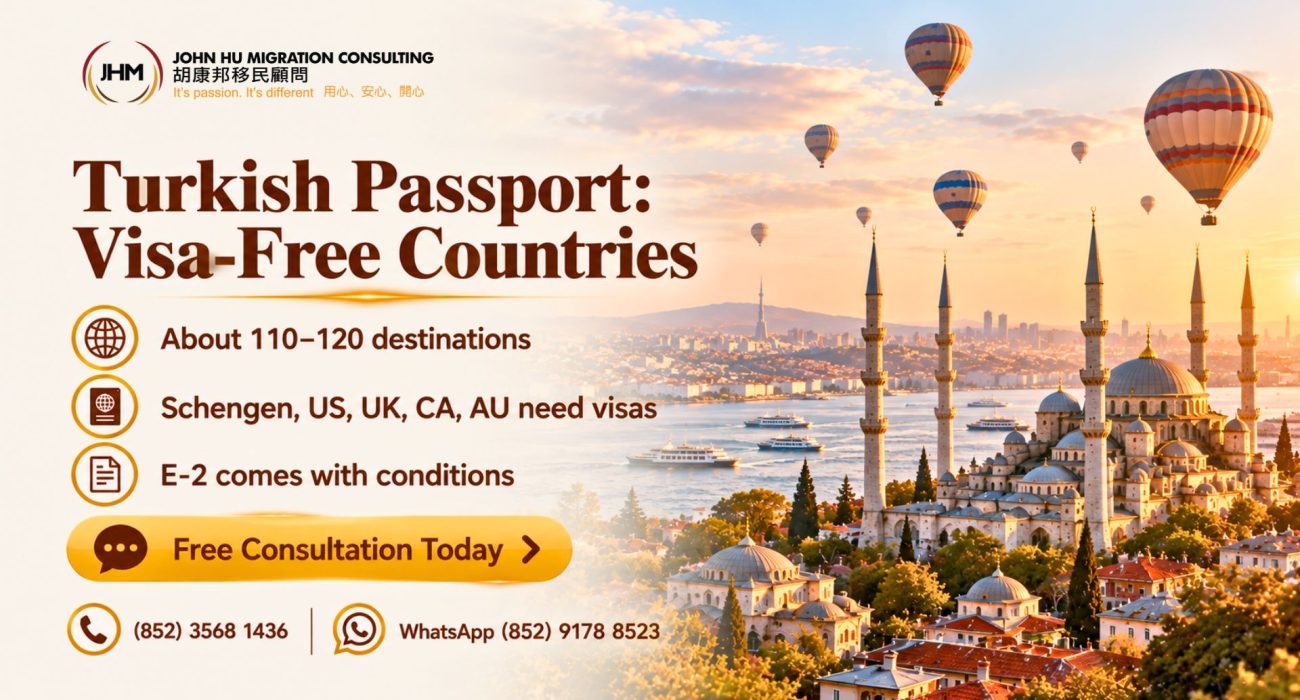
Considering Turkish citizenship by investment, one of the first questions is: how many destinations can a Turkish passport access without arranging a visa in advance? The answer depends on the index and how it classifies visa-free entry, visas on arrival and electronic authorisations. This guide looks at the figures, key exceptions and practical considerations.
1. Why do the numbers differ?
| Source | 2026 snapshot | What is counted |
|---|---|---|
| Henley Passport Index | 112 destinations; rank 49 | Destinations accessible without a prior visa, under Henley’s methodology |
| Passport Index | 121 destinations; rank 42 | 71 visa-free, 43 visa on arrival and 7 electronic authorisations |
These are not necessarily counts of sovereign countries. The indexes use different methodologies and may include territories or different entry arrangements. The figures above were checked on 8 October 2026; rankings and entry rules can change. When quoting a number, name the index and the date.
2. What do “visa-free”, “visa on arrival” and “eTA” mean?
- Visa-free: no visa is normally required for a qualifying short visit, although border officers may ask for supporting documents.
- Visa on arrival: permission is requested at the destination’s border or airport, and eligibility and fees may apply.
- Electronic authorisation: an online approval may be required before travel. This is not the same as unrestricted visa-free access.
None of these short-stay arrangements automatically grants a right to live, work or study long term. Check the official rules for the passport you will use and the purpose and length of your trip.
3. Where can it be useful in practice?
Turkish citizens can access a range of destinations for short visits, but conditions vary. For example, Japan generally allows qualifying Turkish machine-readable passport holders to visit for up to 90 days without a visa. Singapore and Malaysia also have short-stay arrangements for Turkish passport holders, subject to current entry conditions; several Balkan destinations may be accessible without obtaining a visa in advance.
Before booking, check the official Japan visa-exemption information, Singapore entry and visa requirements and Malaysia’s visa requirements by country. Travel permissions can depend on passport format, visit purpose, onward travel and the discretion of immigration authorities.
4. Where is a visa still required?
A Turkish passport is not a universal travel pass. A visa is generally required for Turkish visitors to the Schengen Area, United States, United Kingdom, Canada and Australia, subject to each destination’s rules and any applicable exceptions or authorisations.
Check the official UK visitor visa national list and Canada entry requirements before travel. For Hong Kong families, the passport’s value may relate more to an additional nationality and broader planning options than to the headline visa-access count alone.
5. The US E-2 visa: another route, with conditions
Turkey has an E-2 treaty relationship with the United States. However, holding Turkish citizenship does not itself qualify someone for an E-2 visa. Applicants must meet the treaty-investor requirements, including making a substantial investment in a real and operating US enterprise, and satisfy all applicable visa criteria. An E-2 visa is not a US green card and approval is not guaranteed.
There is also a specific three-year domicile rule for a person who acquired treaty-country nationality through investment or a similar means: US law requires continuous domicile in that treaty country for at least three years at some point before applying for the E-2 visa. It is not simply a rule to obtain a passport and then wait three years. Review the current US Department of State treaty-country information and INA section 101(a)(15)(E), and obtain case-specific US legal advice. For background, see JHM’s article Why Hong Kong investors consider Turkish citizenship and the E-2 visa.
6. Beyond visa-free access: tax, investment route and compliance
Tax: Turkish Law No. 7582 tax benefits depend on meeting the relevant tax-residency and other legal conditions; citizenship alone does not automatically confer them. See The real advantages of a Turkish passport and obtain independent tax advice.
Investment routes: Turkey’s citizenship-by-investment programme includes a real-estate route with a minimum qualifying value of USD 400,000, as well as deposit and fund options. Each route has specific valuation, holding-period, documentation and government-procedure requirements. Read more about Turkey immigration and the Law No. 7579 compliance context before making a commitment.
Dual nationality: Turkey permits dual nationality, but the implications for a Hong Kong or PRC-connected applicant should be checked separately with a qualified adviser before applying.
Frequently asked questions
Can Turkish passport holders enter the Schengen Area visa-free?
No. A Turkish passport does not generally provide visa-free entry to the Schengen Area; check the relevant consulate’s current visitor-visa requirements.
Why do websites give different visa-free counts?
Indexes classify visa-free entry, visas on arrival and electronic authorisations differently. Their destination lists and rankings also change over time.
Does a high visa-access count mean Turkish citizenship is right for me?
Not by itself. Consider your family’s objectives, tax position, investment threshold, residence requirements, compliance risks and the rules of your existing nationality.
For an overview of eligibility and process, see Turkey immigration. John Hu Migration Consulting has supported clients with international identity and asset planning for 17 years and has helped more than 6,000 families, according to company records.
Contact JHM: Call (852) 3568 1436 or WhatsApp (852) 9178 8523, or submit the free assessment form.
Information checked 8 October 2026. Visa rules, index rankings and programme requirements can change. Outcomes, processing times and follow-on status depend on the applicant’s circumstances, documentation and official decisions. This article is general information only, not legal or tax advice, and does not guarantee any visa or citizenship outcome. Confirm travel requirements with the relevant government authority before departure.