



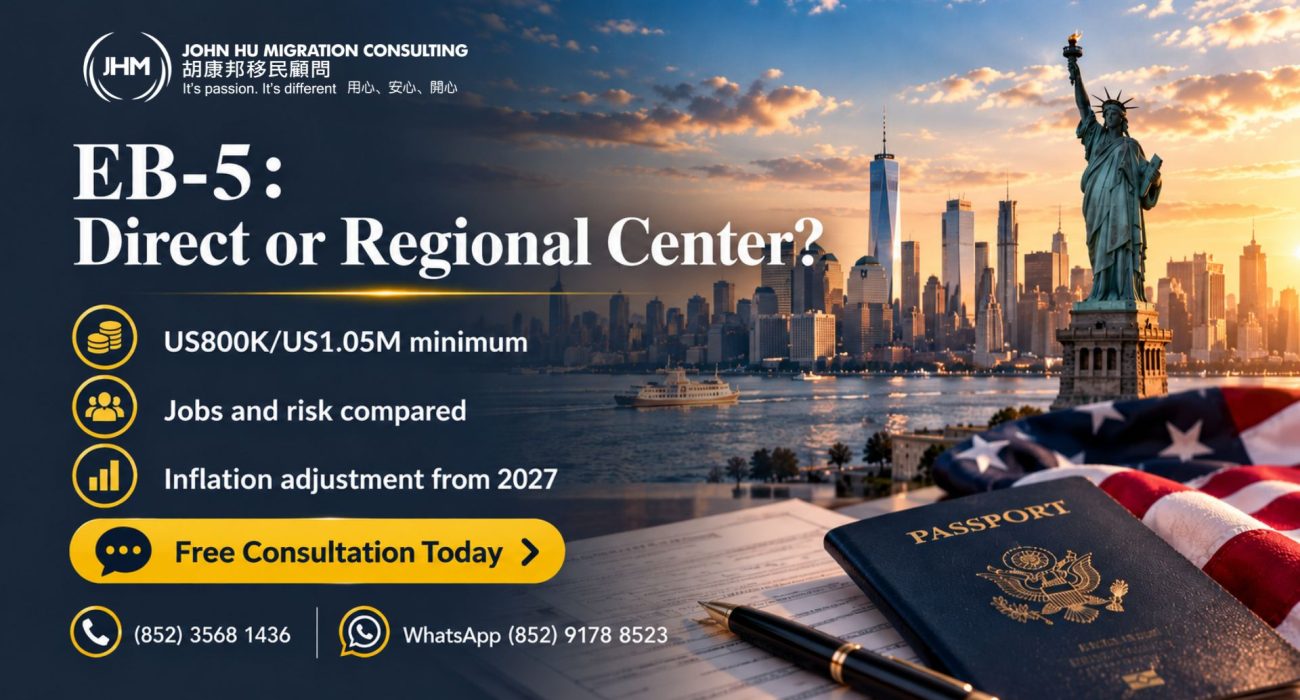
For Hong Kong families considering US investment immigration, the first decision is not necessarily which project to choose, but which structure to use: a direct investment or an investment through a Regional Center. Both routes fall under EB-5 and require qualifying investment and job creation, but they differ in the investor’s management role, how jobs are counted, project risks and policy exposure.
1. What both routes share: minimum investment
Under the EB-5 Reform and Integrity Act of 2022 (RIA), the current minimum investment amounts are:
| Investment location | Minimum |
|---|---|
| Targeted Employment Area (TEA: rural or high-unemployment area) and qualifying infrastructure project | US$800,000 |
| All other areas (non-TEA) | US$1,050,000 |
Both routes require the creation or preservation of at least 10 full-time jobs. The RIA also reserves visas: 20% for rural projects, 10% for high-unemployment areas and 2% for infrastructure. Visa availability can therefore differ by category and applicant; check the monthly Visa Bulletin rather than relying only on the minimum investment amount.
See the EB-5 provisions in the US Code.
2. Direct investment vs Regional Center: six key differences
| Factor | Direct investment | Regional Center |
|---|---|---|
| Structure | Start or acquire a new commercial enterprise yourself or with partners | Invest in a project under a USCIS-designated Regional Center, often through a limited partnership |
| Job counting | Generally, the business directly employs 10 full-time workers | Qualifying indirect and induced jobs may count through economic modelling |
| Investor’s role | Must be engaged in management, day-to-day or through policy formulation | Usually more passive, with no day-to-day operating role |
| Main risks | Operating, staffing and compliance risks rest with the business | Project development, fund management and sponsor credibility require scrutiny |
| Policy exposure | Not dependent on Regional Center reauthorization | Currently authorized through 30 September 2027; continuation depends on Congress |
| May suit | Applicants with business experience willing to participate in a US operation | Applicants who prefer a more passive investment while maintaining their current career and lifestyle |
Under either structure, capital must remain at risk; there is no guarantee of return or principal. Source-of-funds documentation is also stringent. Investors should assess the project and conduct due diligence before committing capital.
3. Policy risk: 30 September 2026 and 30 September 2027
30 September 2026 was the filing cutoff for grandfathering protection for Regional Center cases; it was not the end of EB-5. The Regional Center program is currently authorized through 30 September 2027. Regional Center petitions filed on or after 1 October 2026 can still be filed under the current program, but if the program later lapses they would not have the grandfathering protection associated with the earlier filing cutoff. Applicants should weigh that uncertainty. Direct investment does not depend on Regional Center authorization.
For background, see JHM’s EB-5 30 September myths and the US EB-5 investment immigration overview.
4. Inflation adjustment from 1 January 2027; check filing fees
The RIA provides for a CPI-U adjustment to minimum investment amounts from 1 January 2027, with adjustments every five years thereafter and amounts rounded down to the nearest US$50,000 increment. The TEA/infrastructure amount is 75% of the standard amount. Market analysts project approximately US$900,000–937,500 for TEA and US$1.2–1.25 million for standard investments, but USCIS has not published official figures as of this article’s date. These are unofficial estimates; the amount that applies is determined by the official rules in force on the filing date.
A separate fee change takes effect on 30 November 2026: the I-526E filing fee is scheduled to rise from US$3,675 to US$7,850. A separate US$1,100 Integrity Fund fee is also listed. Check the applicable USCIS fee schedule before filing. See the Federal Register fee rule.
5. How to choose: three questions to ask
- Do you want to run a business in the US? If you want an operating role, explore direct investment; if not, compare Regional Center projects.
- Can you accept uncertainty about reauthorization? Regional Center investors should understand the authorization period and grandfathering distinction. Direct investment is not dependent on Regional Center reauthorization.
- What is your budget and location tier? The current gap between TEA and non-TEA minimums is US$250,000, and the scheduled 2027 inflation adjustment means it is sensible to allow for additional budget.
Frequently asked questions
Which route is faster?
There is no universal answer. Timing depends on the category, visa availability and USCIS workload. Review the latest Visa Bulletin and USCIS processing-time information and obtain advice for your circumstances.
Are returns guaranteed in Regional Center projects?
No. EB-5 capital must be at risk. Any projected return is not a guarantee, and investors should assess the risks and conduct due diligence.
Can I consider both routes?
Yes. Confirm the application strategy, source of funds and project due diligence with qualified legal counsel on a case-by-case basis.
To learn more about US EB-5 investment immigration, eligibility, investment amounts and process, arrange an assessment with JHM. For US immigration matters, John Hu Migration Consulting works with the team of New York-licensed attorney Susan Akina to provide relevant professional support.
Hotline: (852) 3568 1436 WhatsApp: (852) 9178 8523
Request a free assessment
Disclaimer: Outcomes, processing times and follow-on status arrangements vary by applicant background, project circumstances, documentation and official requirements. EB-5 involves investment risk and there is no guarantee of return or principal. 2027 investment amounts are unofficial projections; USCIS figures and applicable rules prevail. This article is for general information only and is not a guarantee of approval, legal advice or investment advice.
Sources: EB-5 Reform and Integrity Act of 2022 (RIA); Scott Legal P.C. (12 March 2026); CanAm Enterprises (July 2026); USCIS EB-5 page; US Code and Federal Register fee rule.