



Reviewed by John Hu, founder of John Hu Migration Consulting and Registered Migration Agent (MARN 0746141).
A market breaking transaction records while real prices are actually correcting. Red-hot domestic demand while foreign investors have stayed on the sidelines for years. Interest rates near multi-year highs while sales keep climbing. Turkey’s real estate market in 2025-2026 is full of seemingly contradictory signals — and those contradictions are exactly where investors who read the data correctly can find opportunity.
This report draws on official data from the Turkish Statistical Institute (TUIK), the Central Bank of the Republic of Turkey (CBRT), and international research organizations, giving Hong Kong investors evaluating Turkey’s citizenship-by-investment program the complete picture they need before deciding.
Market Liquidity: A Record-Breaking 2025
According to official TUIK data, Turkey recorded 1,760,292 national housing transactions in 2025, up 13.58% year-on-year. Resale properties accounted for 68% of transactions, up 15.24% YoY, while new-build sales grew a more modest 10.28%.
Including commercial property and land transactions, Turkey’s total real estate transaction volume for 2025 exceeded 3.24 million units — an all-time record.
What’s more notable is what’s behind the growth: according to Turkey’s Real Estate Investors Association (GYODER), the surge is driven by expectations of falling interest rates, real estate’s role as a store of value, and internal migration demand following the February 2023 earthquake — this is genuine demand, not speculation.
The Price Puzzle: Nominal vs. Real Prices
This is the most complex — and most commonly misread — aspect of Turkey’s real estate market for overseas buyers.
1- Nominal Prices Are Rising Sharply
According to CBRT, the Residential Property Price Index (RPPI) rose 26.36% year-on-year as of February 2026\. Istanbul — the country’s most expensive market — rose 27.99% YoY. Over the past decade (2015-2025), the RPPI has climbed more than 11-fold.
2- Real Prices Are Actually Correcting
Adjusted for inflation, however, real prices in Istanbul actually fell 2.69% over the same period. Nationally, real prices fell 3.93%.
What does this mean for overseas investors?
The key to reading Turkey’s market correctly is to think in USD, not TRY. While local buyers face inflationary pressure, USD-denominated foreign investors are currently benefiting from a genuine “window of opportunity” — acquiring quality assets at a dollar price below their real value within the local economy.
3- Real Price Levels in Istanbul
In Q4 2025, the national average price was TRY 45,447/m² (approximately USD 1,076/m²). Istanbul remains the country’s most expensive market at TRY 74,101/m² (approximately USD 1,755/m²).
Rental Yields: Outperforming Europe
Turkey’s tourism revenue hit a record USD 65.2 billion in 2025, with 52.8 million foreign visitors — providing solid year-round support for the short-term rental market.
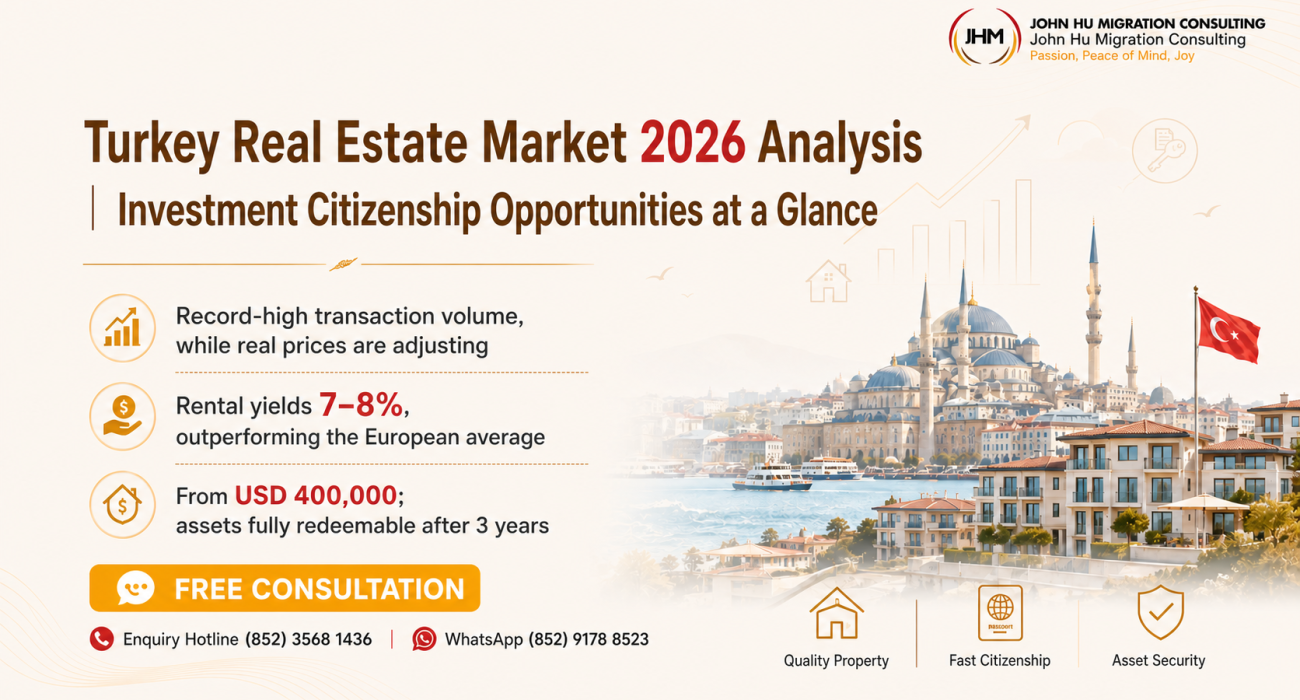
National gross rental yields hold steady at 7%-8%, more than double the European average of 2%-4%. In central Istanbul, long-term rental yields regularly exceed 5%.
This is the fundamental difference between Turkish real estate and many other golden visa property options: it’s not just appreciation — it generates ongoing cash flow while appreciating.
Market Size and Outlook
Turkey’s residential real estate market was valued at USD 71.11 billion in 2025 and is projected to reach USD 90.49 billion by 2030, a CAGR of 6.68%.
Turkey’s economy grew 3.6% in 2025 (up from 3.2% in 2024), with GDP reaching approximately USD 1.6 trillion. Notably, this growth occurred with interest rates holding at 37% or higher throughout the year — a sign that underlying economic fundamentals are far more robust than the headline rate suggests.
Inflation and Interest Rate Trends: Moving in the Right Direction
Turkey’s consumer price inflation peaked at 75.45% in May 2024 and has since declined steadily to 32.61% by May 2026\. The policy rate has fallen in tandem, from a peak of 50% to 37%.
CBRT’s total foreign exchange reserves reached USD 215.6 billion (as of 23 January 2026\) — an all-time high, providing substantial “policy room” to absorb external shocks.
This trend matters for investors: each future rate cut is expected to release more pent-up domestic demand into the real estate market — adding further upward pressure on prices.
Foreign Investors: Opportunity in a “Quiet” Market
Foreign investor participation currently sits at its lowest level in 9 years — an interesting contrast to a market that’s otherwise breaking records.
This creates opportunity: when the domestic market is strong but foreign investors haven’t yet returned, it’s often the moment when pricing is most attractive. Add to this Law No. 7582, which introduces a 20-year foreign income tax exemption effective June 2026, and Turkey is offering international investors a comprehensive incentive package unlike anything seen before.
Market Analysis by Segment and Region
1- Istanbul — The Core Market
Istanbul accounts for 17% of national housing transactions, remaining the city with the highest investment demand. Three main segments serve different investment goals:
- CBD apartments: High rental yield, low vacancy — best for maximizing cash flow
- Developing-area apartments (Bağcılar, Beylikdüzü, Başakşehir): Priced 30-50% below the center, with upside potential as infrastructure develops
- West Istanbul villas: A hard asset that hedges against inflation, with 60-70% of value allocated to land — one of the few asset types that doesn’t depreciate over time
2- Antalya and Muğla — The Coastal Market
Muğla recorded an average price of TRY 76,619/m² (approximately USD 1,815/m²), the highest in the country, reflecting the premium quality of Turkey’s top coastal markets.
Risks to Recognize
- Currency risk: The lira remains on a long-term depreciation trend. Investors need a currency-hedging strategy, or should be prepared to hold long-term to optimize USD-denominated returns
- Inflation risk: Though declining, inflation remains elevated at 32.61%, affecting TRY-denominated operating costs
- Policy risk: The CBI program and various tax incentives may change with shifts in government; ongoing monitoring is essential
- Project legal risk: Some off-plan projects lack transparency; rigorous legal due diligence is essential before signing any contract
What This Means for Hong Kong Investors
Turkey’s real estate route to citizenship by investment requires a minimum investment of USD 400,000 in a compliant property, redeemable in full after a 3-year holding period, with no language, education, or residency requirements — and the principal applicant can bring a spouse and children under 18 to obtain a second passport together. Compared with several Caribbean CBI programs that have tightened screening, raised prices, or scrapped non-refundable donation options in recent years, Turkey maintains relatively accessible requirements — no minimum stay, a single entry to complete the process, and full asset redemption.
For Hong Kong families planning identity diversification and global asset allocation, this market data shows that Turkish real estate isn’t just a compliance vehicle for a second passport — its 7%-8% rental yield and potential for appreciation carry genuine standalone investment value, a dual benefit many other CBI programs (such as those based on non-refundable donations) simply don’t offer.
FAQ
- Nominal prices in Turkey are up more than 26% — does that mean it's now too expensive to invest?
It depends how you look at it. The nominal increase reflects TRY-denominated inflation. After adjusting for inflation, real prices in Istanbul actually fell around 2.69%. USD-denominated foreign investors are, in effect, in a relatively favorable entry position.
- If I invest in real estate for Turkey's citizenship-by-investment program, can I rent out the property?
Yes. You can rent it out for income during the holding period, and sell it once the 3-year holding requirement is met, with proceeds fully repatriable.
To learn the full requirements and process for Turkey’s citizenship-by-investment program, see Turkey immigration details; for a comparison of Turkey’s advantages against tightening Caribbean CBI programs.
John Hu Migration Consulting has spent over 17 years helping more than 6,000 families successfully plan overseas identity and global asset allocation. Turkish real estate investment for citizenship purposes involves market analysis, legal due diligence, and currency strategy across multiple dimensions — having an adviser team that knows the local market end-to-end is key to protecting both the investment and the citizenship outcome.
Outcomes, processing times, and follow-on status arrangements vary by applicant background, case specifics, documentation completeness, and official approval requirements. The above is for reference only and does not constitute a guarantee of approval or investment advice.
📞 Enquiry Hotline: (852) 3568 1436 WhatsApp: (852) 9178 8523
Fill out our free assessment form to have our team walk you through a feasible plan for Turkish real estate citizenship-by-investment.