


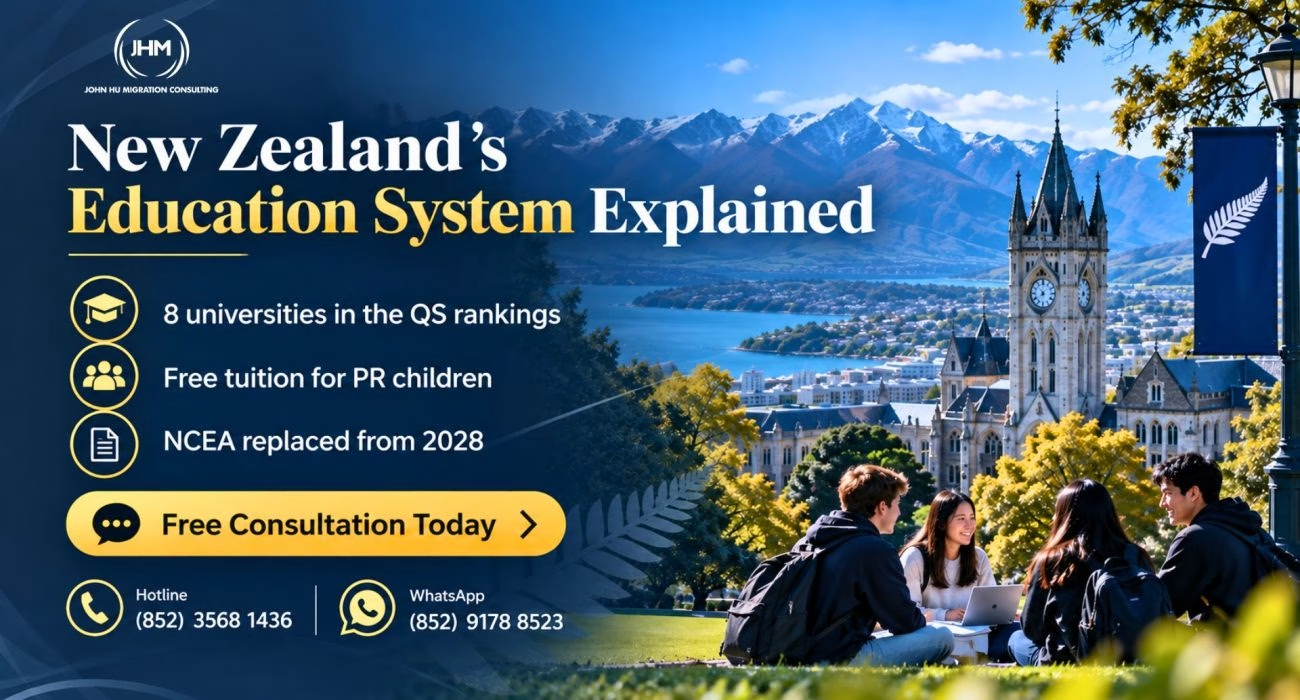
New Zealand’s education system spans three tiers: Early Childhood Education (ECE) (ages 0-5), compulsory education (primary through secondary, Years 1-13), and higher education, with 8 public universities — all overseen by the Ministry of Education and internationally recognized through NZQA.
Education is often a major consideration for Hong Kong families weighing immigration to New Zealand — children can attend a high-quality public education system, and once holding permanent residency, entirely free of charge.
How Many Tiers Does New Zealand’s Education System Have?
New Zealand’s education system is overseen by the Ministry of Education, with two subsidiary bodies: NZQA (qualifications quality and certification) and TEC (tertiary education).
- Built on the foundations of the UK education system, with qualifications widely recognized globally
- A 99% literacy rate, among the world’s leading English-language education systems
Early Childhood Education (ECE)
Not compulsory, but more than 95% of New Zealand children participate before entering Year 1, following the Te Whāriki curriculum framework.
- Citizens’/permanent residents’ children aged 3+ receive 20 hours of free ECE per week at qualifying facilities
- Common forms: Kindergarten (public preschool), Childcare Centre (private), Kōhanga Reo (Māori language immersion)
Compulsory Education: Primary and Secondary School
Runs from age 6 to 16 (Years 1-11), split into primary (Years 1-8) and secondary (Years 9-13); Years 12-13 aren’t compulsory, but most students continue in order to earn an NCEA qualification and progress to university.
- State Schools: fully free for citizens/permanent residents
- State-Integrated Schools: teach according to their own philosophy or religious character, and may charge additional facility fees
- Private Schools: not state-funded, with tuition fully covered by parents
- Since 2023, New Zealand has used the Equity Index (EQI) to replace the former “Decile” rating, allocating support funding based on students’ socio-economic circumstances — this is not a measure of teaching quality, though many parents still misread it as one.
NCEA Will Be Replaced Between 2028 and 2030
NCEA (National Certificate of Educational Achievement) is the current secondary school qualification, with Levels 1-3 corresponding to Years 11-13. The New Zealand Government has confirmed (26 March 2026) that it will be fully replaced by a new qualification system between 2028 and 2030 — the largest secondary education reform in more than 20 years.
- NCEA Level 3, alongside University Entrance (UE), is required for university admission
- From 2028, Year 11 will require compulsory English and Maths under the new foundational qualification, while Years 12-13 shift to subject-based grading, replacing the current free-credit accumulation model
- Families with secondary-school-age children should monitor this transition closely when planning their move
Higher Education: 8 Public Universities
New Zealand has 8 public universities, all ranked in the QS World University Rankings, led by the University of Auckland (around 65th globally).
| University | QS Ranking 2026 | Strengths |
|---|---|---|
| University of Auckland | ~65 | Multi-disciplinary, largest scale |
| University of Otago | ~197 | Medicine, health sciences |
| Massey University | ~230 | Business, aviation, veterinary science |
| Victoria University of Wellington | ~240 | Law, social sciences |
| University of Canterbury | ~261 | Engineering, fine arts |
| University of Waikato | ~281 | Business, management |
| Lincoln University | ~407 | Agriculture, environment |
| Auckland University of Technology (AUT) | ~410 | Nursing, hospitality, tourism |
Beyond universities, New Zealand’s education system also includes Institutes of Technology and Polytechnics (ITP) (vocational training), Private Training Establishments (PTE), and Wānanga (Māori cultural education). All 8 universities offer their own scholarships, most commonly merit-based entry scholarships, which are also open to international students.
Education Costs by Level
Citizens and permanent residents attend public schools free of charge from primary through secondary; international students pay tuition at every level, with university fees ranging from NZD 26,000 to 58,000+ per year depending on the field.
- Compulsory education (citizen/PR): free, with only incidental costs like books and uniforms
- Compulsory education (international): approximately NZD 15,000-22,000/year
- University (citizen/PR): domestic tuition, significantly lower than international rates, with access to interest-free student loans
- University (international): NZD 26,000-58,000+/year, highest in engineering and health sciences (which can exceed NZD 60,000-95,000/year)
This is also part of the broader cost-of-living picture that families planning a move to New Zealand should factor into their overall plan.
Free Tuition for Immigrant Families’ Children
Once someone becomes a New Zealand permanent resident, their children are entitled to fully free tuition at public schools from primary through secondary — one of the most financially valuable benefits within any immigration pathway.
- Many families investing through an Active Investor Plus Visa treat their children’s education as a major motivator alongside their financial goals
- Families need to maintain the relevant minimum residency requirements to keep this benefit continuous throughout their child’s schooling
- The longer-term goal — New Zealand citizenship — unlocks further scholarships and support programs reserved specifically for citizens
FAQ
Are the children of New Zealand permanent residents entitled to free tuition?
Yes. Children of New Zealand permanent residents or citizens can attend public school free of charge from primary through secondary.
Will NCEA be fully replaced?
Yes. The New Zealand Government confirmed on 26 March 2026 that NCEA will be fully replaced by a new qualification system between 2028 and 2030.
Which New Zealand university ranks highest?
The University of Auckland, ranked around 65th-67th in the QS World University Rankings.
Planning Education and Immigration Together
To learn how to obtain New Zealand permanent residency through investment and unlock free tuition for your children, visit JHM’s free assessment page and discuss your family’s education and immigration timeline.
John Hu Migration Consulting has spent 17 years helping more than 6,000 families relocate successfully, and is one of the few firms in Hong Kong with directly licensed immigration advisers in both Australia (MARA) and New Zealand (IAA), offering a one-stop service from visa applications and property arrangements to school enrollment.
Important: Outcomes, processing times, and follow-on status arrangements vary by applicant background, case specifics, documentation completeness, and official approval requirements. The above is for reference only and does not constitute a guarantee of approval or investment advice.
📞 Enquiry Hotline: (852) 3568 1436 WhatsApp: (852) 9178 8523
Complete our free assessment form to have our team help plan your children’s education alongside your immigration timeline.