



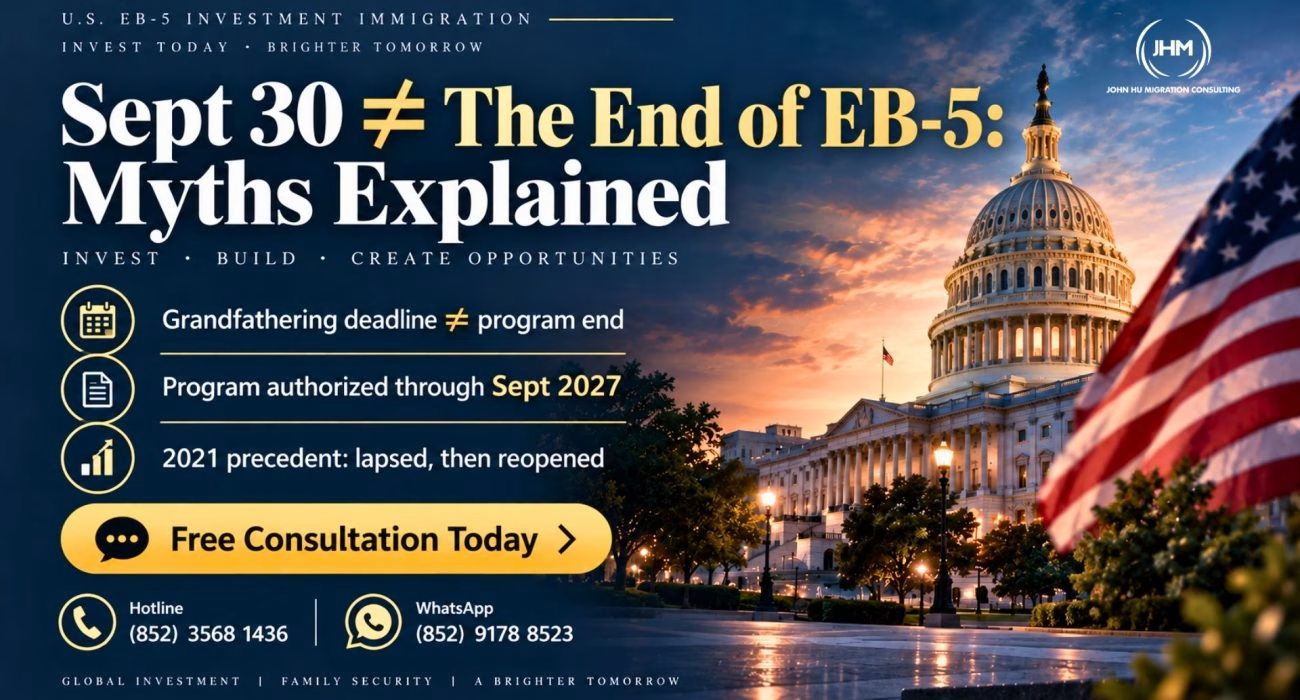
30 September 2026 is the filing deadline for EB-5 investment immigration’s Grandfathering protection mechanism — but that does not mean the EB-5 program itself ends that day. The Regional Center Program’s current authorization runs through 30 September 2027. Getting this distinction right is the first and most important step in planning your application timeline.
Core Concept: Understanding Grandfathering Correctly
Under the Grandfathering provision in Section 203(b)(5)(S) of the Immigration and Nationality Act (INA), if the Regional Center Program subsequently lapses, the Department of Homeland Security (DHS) must still process applications filed on or before 30 September 2026.
An application won’t be refused simply because the program has lapsed; visa issuance for beneficiaries of already-accepted applications won’t be suspended for that reason either. This mechanism first appeared in the 2022 EB-5 Reform and Integrity Act (RIA) — for more than 30 years before that, EB-5 law had never contained a similar provision.
The key point to clarify: 30 September 2026 is not the day the EB-5 program ends. It’s simply the dividing line for which applications qualify for Grandfathering protection. An I-526E filed on 1 October 2026 remains within the program’s valid authorization period — it just no longer carries Grandfathering protection.
Three Timeline Milestones, Three Separate Factors
| Milestone | Factor Affected | What Changes After |
|---|---|---|
| 30 September 2026 | Grandfathering mechanism | Applications filed after this date no longer receive Grandfathering protection |
| 1 January 2027 | Investment amount | Begins adjusting for inflation, repeating every 5 years thereafter |
| 30 September 2027 | Program authorization | Requires Congressional renewal to continue operating |
A Historical Lesson: What Actually Happened in 2021
What happened:
On 30 June 2021, the Regional Center Program lapsed, interrupting the program for nearly 9 months.
How applications were handled:
USCIS paused processing but preserved the existing status of pending applications, and did not accept new regional-center-category applications during this period.
The outcome:
The program wasn’t abolished — it reopened alongside RIA, with a considerably stricter regulatory framework.
Worth treating with caution:
This is the only precedent available, so it should be referenced carefully. The legal framework today is different — applications filed before 30 September 2026 are protected by Grandfathering, a safeguard 2021 investors never had.
6 Reasons Renewal Is More Likely Than Program Closure
A. Legislative History
When significant problems arise, Congress has historically favored reforming the program over abolishing it outright.
B. The Structure of RIA 2022
RIA itself already extends the program to 2027, while raising transparency requirements, establishing an integrity fund, and strengthening oversight of both projects and intermediaries — signaling Congress’s preference for extending the program under stricter regulation, rather than ending it.
C. The 2021 Precedent
The program lapsed once before and still managed to reopen and resume operating.
D. The Scale of Capital Involved
Between 2016 and 2019, EB-5 raised approximately USD 17.5 billion in capital, a substantial share of the USD 75.2 billion in total project capital — underscoring how significant the program is to the capital chains of related industries.
E. Economic Impact
The program is estimated to have created approximately 1.7 million jobs and contributed roughly USD 184 billion to US GDP (source: IIUSA).
F. Bipartisan Consensus
RIA is the product of years of cross-party collaboration between Senator Chuck Grassley and the late Senator Patrick Leahy — reflecting genuine bipartisan support for the program within Congress, rather than a single-party position.
Minimum Investment Amounts From 2027
| Project type | Current minimum investment |
|---|---|
| Targeted Employment Area (TEA) or qualifying infrastructure project | USD 800,000 |
| Standard amount | USD 1,050,000 |
RIA has formally written an automatic inflation-adjustment mechanism into law, taking effect from 1 January 2027 and repeating every 5 years thereafter.
Worth noting: DHS has not yet officially published the specific amount effective from 2027. Based on the statutory formula and available inflation data, the TEA amount is projected at roughly USD 900,000 or higher — though this remains a projection, not a figure confirmed by the US government.
(A note: different sources’ projections for the 2027 investment amount vary somewhat — this estimate suggests around USD 900,000 or higher, while other projections point to a range of USD 930,000-950,000, with the difference stemming from the inflation data and calculation baseline each uses. Treat this as a rough reference range; the actual figure will depend on DHS’s official announcement.)
Between 1 October and 31 December 2026: the program remains valid, and the amount stays at USD 800,000. The only difference is that applications filed during this window no longer receive Grandfathering protection.
Filing After 30 September 2026: What You Actually Get, and Myths to Avoid
What doesn’t change:
- ✅ The program’s authorization continues through 30 September 2027
- ✅ Applications filed from 1 October 2026 onward remain within the program’s valid period
- ✅ Applications filed in the final 3 months of 2026 still qualify for the current investment amount
- ✅ 30 years of practice show the program has consistently continued through cycles of reform and refinement
Myths to avoid:
- ❌ Assuming Grandfathering protection still applies if the program lapses after 30 September 2027
- ❌ Assuming the investment amount stays the same after 1 January 2027
- ❌ Assuming review standards and transparency requirements stay unchanged
- ❌ Assuming the program is “guaranteed” to be renewed
The EB-5 opportunity still exists after 30 September 2026. What genuinely changes is that investors need a clearer understanding of the type of risk they’re accepting, their planned filing timing, and the potential investment amount increase starting in 2027.
FAQ
If 30 September 2026 doesn’t end EB-5, why does the date still matter so much?
Because it’s the filing deadline for Grandfathering protection — determining which applications remain legally shielded from later policy changes if the Regional Center Program subsequently lapses after 30 September 2027. It remains a critical consideration when planning your filing timeline.
If I plan to wait until 2027 to apply, has my opportunity already disappeared?
No. The program remains authorized through at least 30 September 2027, and applications filed after 1 October 2026 remain legally valid — they simply won’t carry Grandfathering protection, and may face a higher, inflation-adjusted investment amount along with greater policy uncertainty down the line.
To fully understand EB-5’s complete timeline and the 3 key milestones, see “3 Timeline Milestones Every EB-5 Investor Should Know Before Filing”; for the full application requirements, see “US EB-5 investment immigration details”.
Important reminder: Outcomes, processing times, and follow-on status arrangements vary by applicant background, case specifics, documentation completeness, and official approval requirements. The 2027 investment amount cited in this article is an unofficial projection; the actual figure will follow DHS’s official announcement. The above is for reference only and does not constitute a guarantee of approval or investment advice.
John Hu Migration Consulting
John Hu Migration Consulting was founded in March 2009 and has spent 17 years accompanying more than 6,000 families through successful immigration to the US and other developed countries. For US-specific casework, JHM partners with New York-licensed immigration attorney Susan Akina’s team, who liaise directly with USCIS and track the latest policy shifts and adjudication trends.
📞 Enquiry Hotline: (852) 3568 1436 WhatsApp:(852) 9178 8523