



Reviewed by John Hu, founder of John Hu Migration Consulting and Registered Migration Agent (MARN 0746141).
The Active Investor Plus Visa (AIP) is New Zealand’s premium investment migration program, designed to attract high-quality capital that delivers a genuine, lasting positive impact on the national economy. What sets this program apart is the investment itself: simply having the money isn’t enough for approval — investors must invest in the right type, structure, and economic target as defined by the New Zealand Government to meet the AIP investment requirements.
Below is a full breakdown of every accepted investment form — what each one is, what investors need to understand, and the risks and considerations involved.
What Constitutes an Acceptable Investment
An investment only qualifies as an “acceptable investment” when it meets all of the following:
- Not for personal use
- Invested in New Zealand, denominated in NZD
- Falls within the approved list of investment forms
- Maintained continuously throughout the mandatory investment period — 3 years for Growth Category, 5 years for Balanced Category
The investment value is determined at the time of investment, and includes:
- Management fees
- Transaction fees
- Brokerage and related costs
The Two Investment Categories Under AIP
New Zealand’s investment immigration program under AIP splits into two choices: Growth Category and Balanced Category, each with different minimum investment amounts and requirements.
1. Growth Category
- Minimum investment: NZD 5 million
- Eligible investment forms:
– Direct investment into a New Zealand private business
– Investment through managed funds vetted by New Zealand Trade and Enterprise (NZTE)
- Investment must target businesses with genuine growth potential — not personal assets, owner-occupied real estate, vehicles, or consumption purposes
2. Balanced Category
- Minimum investment: NZD 10 million
- Allows a more diversified portfolio, including:
– Direct investment
– Managed funds
– Listed equities
– Bonds (newly added from 1 April 2025)
– Real estate development projects (new housing, commercial, industrial, or redevelopment of existing projects)
– Philanthropic giving
- Investors can also allocate a portion of funds into “Growth”-type investments within a Balanced portfolio
- There’s no longer a cap on maximum allocation per asset type (for instance, the previous 50% cap on listed equities has been removed)
Investment Forms Accepted Under AIP
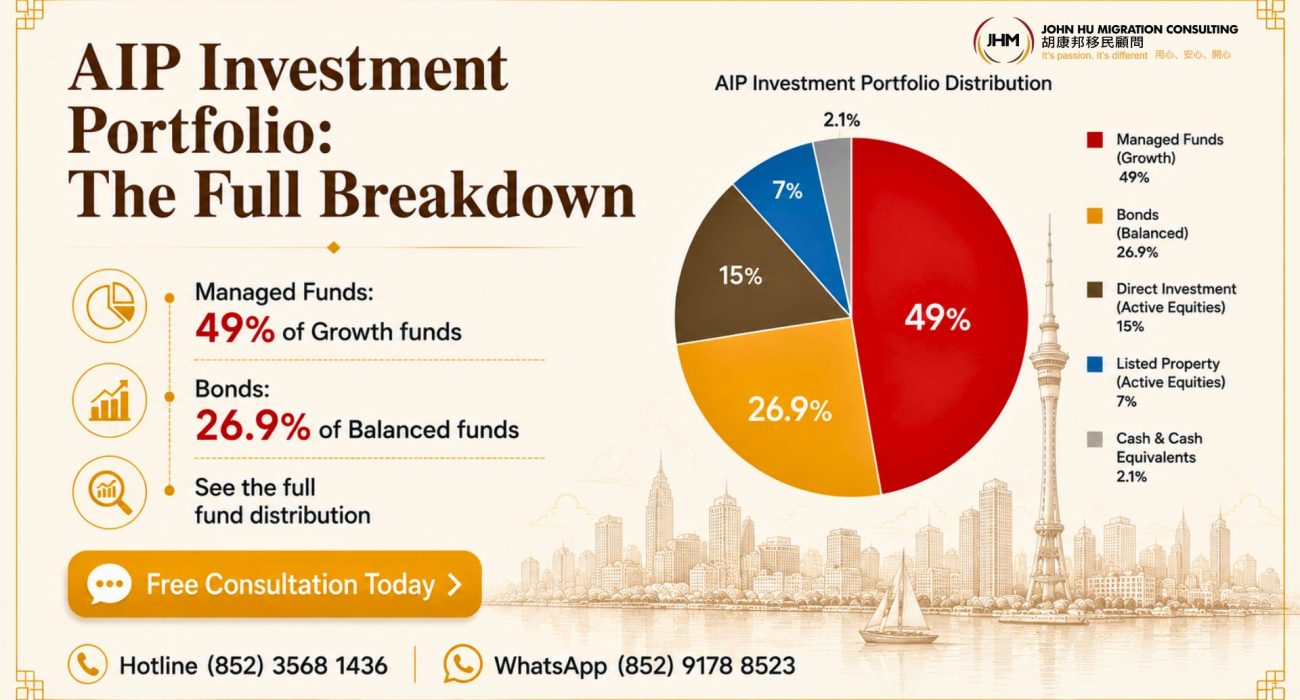
1. Managed Funds — The Most Common Form, 49% of Growth Funds
What are Managed Funds?
Managed funds involve pooling capital into a fund managed by professional investment managers in New Zealand. The fund then allocates capital to specific assets per its published strategy — private credit, venture capital, private equity, infrastructure, or a combination.
Why are Managed Funds so popular?
According to INZ data, managed funds account for 49% of total Growth Category funds — equivalent to NZD 725.4 million. This isn’t accidental. Managed funds are popular because:
- Investors don’t need professional investment management expertise in New Zealand
- The fund has already been vetted and pre-approved by INZ/Invest New Zealand
- Risk is spread across multiple assets within the portfolio
- No direct asset oversight is needed — well-suited to investors based in Hong Kong
Types of Managed Funds Within Growth Category:
1. Private Credit — NZD 515.7 million (34.8%)
This fund type lends directly to New Zealand private businesses, replacing traditional bank lending. Investors earn interest on these loans. Private credit is the single most common investment form across the entire AIP program — accounting for nearly 35% of all Growth Category funds.
Why is private credit the most favored? Because it carries fixed-income-like characteristics, periodic interest payments, and a clearer capital-protection structure than equity investments. For investors prioritizing capital preservation over the 3-year investment period, it’s the natural choice.
2. Venture Capital — NZD 96.1 million (6.5%)
Funds investing in startups and early-stage New Zealand businesses. Higher growth potential comes with higher risk, suiting experienced investors comfortable with a longer risk horizon.
3. Private Equity — NZD 60.3 million (4.1%)
Funds acquiring shares in already-stable private New Zealand businesses — not startups, but companies with real revenue. Lower risk than venture capital, though also less liquid.
4. Fund of Funds — NZD 30 million (2%)
Funds that invest across multiple other funds, adding an extra layer of diversification. Suited to investors wanting maximum risk dispersion.
5. Multi-strategy — NZD 20.3 million (1.4%)
Funds combining multiple investment strategies within a single structure — more flexible, but also structurally more complex.
6. Infrastructure — NZD 3 million (under 1%)
Funds investing in infrastructure such as renewable energy, telecommunications, and transport. An emerging segment within the AIP portfolio — still small in absolute terms, but actively encouraged by INZ.
2. Discretionary Investment Management Services (DIMS) — NZD 246.5 million (16.6%)
What is DIMS?
DIMS is a discretionary investment management arrangement, where an investor authorizes a New Zealand-licensed organization to make full investment decisions within an agreed framework, without needing the investor’s sign-off on each individual transaction.
How does DIMS differ from Managed Funds?
| Metric | Managed Funds | DIMS |
|---|---|---|
| Asset ownership | Investor owns fund units | Investor owns assets directly |
| Personalization | Shared portfolio across all investors | A dedicated portfolio per investor |
| Flexibility | Fixed to the fund’s strategy | More flexible — can be adjusted on request |
| Transparency | Periodic reporting | Per-transaction reporting |
| Typical capital scale | Suits all sizes | Usually suits larger capital |
DIMS accounts for 16.6% of total Growth Category funds — a meaningful figure showing that a fair number of investors prefer a personalized portfolio over investing in a pooled fund.
Worth noting: any organization providing DIMS must be licensed by New Zealand’s Financial Markets Authority (FMA) — not every organization qualifies. INZ reviews both the DIMS provider and the proposed investment portfolio as part of the AIP approval process.
3. Direct Investments — NZD 20.4 million (1.4%)
What are Direct Investments?
Direct investment means investing directly into a specific private New Zealand business — buying shares or contributing capital directly, without going through a fund intermediary.
Conditions for INZ to accept a direct investment:
- The business must operate lawfully in New Zealand
- It must not fall within excluded industries (drop-shipping, gambling, tobacco, fast-food franchises, outsourced labor, etc.)
- Invest New Zealand must confirm the investment meets requirements
- The investment cannot be into a business owned by close relatives
Why is direct investment’s share so low (1.4%)?
Because direct investment requires investors to personally conduct due diligence on a New Zealand business — complex, time-consuming work, especially for investors without an existing network in New Zealand. Most investors choose managed funds or DIMS to avoid this burden.
4. Investment Forms Exclusive to Balanced Category
The following three forms are only available under Balanced Category (NZD 10 million):
4.1. Bonds — NZD 398.5 million (26.9%)
Bonds are a fixed-term lending arrangement to the New Zealand Government, local government, or approved businesses. Investors receive periodic fixed interest and get their principal back at maturity.
Bonds are the most common form within Balanced Category — accounting for 26.9% of the entire program’s funds. Why: New Zealand government bonds carry the lowest risk level, offer high liquidity, and are viewed favorably by INZ for their direct contribution to public finances.
4.2. Listed Equities — NZD 66.2 million (4.5%)
Shares listed on the New Zealand Stock Exchange (NZX). This is the most familiar form for investors experienced in equity markets, but it’s only available under Balanced Category, not Growth.
4.3. Property Development — NZD 22 million (1.5%)
Developing commercial real estate or new housing in New Zealand — not buying existing real estate for passive rental income. INZ draws a clear line: investing in real estate development projects (creating new assets, creating jobs) is accepted; buying existing property for passive rental income is not.
FAQ
- How should I choose between Growth Category and Balanced Category?
Growth Category has a lower threshold (NZD 5 million) and a shorter investment period (3 years), but its accepted investment forms concentrate on growth-oriented business assets. Balanced Category has a higher threshold (NZD 10 million) and a longer investment period (5 years), but allows a more diversified portfolio, including bonds and real estate development. The right choice depends on your capital scale, risk tolerance, and preferred investment horizon.
- Private credit has the largest share — does that mean it's the lowest risk?
Private credit does carry a clearer capital-protection structure and periodic interest payments, making it relatively lower risk than equity-type investments — but it's not risk-free. The creditworthiness and repayment capacity of the borrowing businesses is still a factor worth evaluating. It's worth working with a licensed adviser to understand the specific risk rating of any given fund.
To fully understand the Active Investor Plus Visa’s requirements, review New Zealand’s Active Investor Plus visa details; for the latest requirements on fund sources and gift documentation, see New Zealand’s 2026 Active Investor Plus Update: Fund Source and Gift Evidence Requirements.
John Hu Migration Consulting is one of the few firms in Hong Kong with two directly licensed immigration advisers — MARA-registered for Australia and IAA-licensed for New Zealand — and has helped more than 6,000 families relocate successfully over 17 years. Choosing an AIP investment portfolio — from Managed Funds and DIMS to Direct Investments and Balanced Category-exclusive tools — involves multiple layers of professional judgment around risk rating, liquidity, and INZ approval standards, and having a licensed adviser oversee the process is key to protecting both your investment and your immigration outcome.
- Outcomes, processing times, and follow-on status arrangements vary by applicant background, case specifics, documentation completeness, and official approval requirements. The above is for reference only and does not constitute a guarantee of approval or investment advice.*
📞 Enquiry Hotline: (852) 3568 1436 WhatsApp: (852) 9178 8523
Fill out our free assessment form to have a licensed adviser help you design the right AIP investment portfolio.