



Reviewed by John Hu, founder of John Hu Migration Consulting and Registered Migration Agent (MARN 0746141).
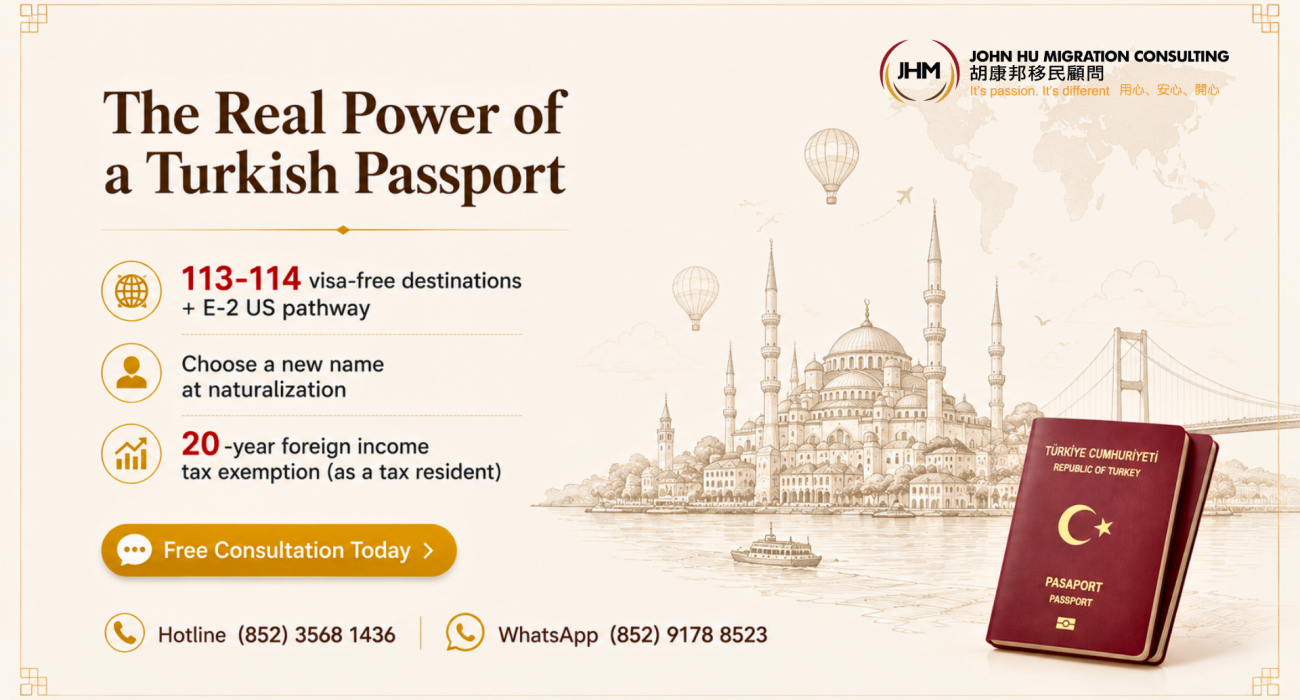
The value of a Turkish passport extends beyond visa-free numbers: it includes a name-choice mechanism at naturalization, access to an E-2 treaty route to the US, and a new tax arrangement taking effect in 2026. Each benefit has conditions that investors should understand.
Freedom of Movement
According to the Henley Passport Index, as of January 2026 a Turkish passport provides approximately 113–114 visa-free, visa-on-arrival or e-visa destinations (around 51st–52nd globally). Access includes Japan for 90 days and Singapore/Hong Kong for 30 days, but does not include Schengen, the US, UK or Canada. Turkey’s E-2 treaty with the US may allow naturalized citizens to apply for an E-2 investor visa.
A Legal Name Choice at Naturalization
During entry into Turkey’s population register, an investor may propose the name recorded on the passport. The name must use the Latin alphabet and comply with Turkish spelling rules. The choice is voluntary, subject to family-name rules for spouses. A later change requires a court process under Article 27 of the Turkish Civil Code and a legitimate reason; Istanbul lawyers estimate 6–9 months.
Turkey permits dual citizenship under Article 3/b of Nationality Law No. 5901, but the investor’s original nationality law must be checked separately. A new Turkish passport name may differ from a Hong Kong ID or BNO passport name.
Tax Optimisation: Law No. 7582
On 4 June 2026, Turkey published Law No. 7582, providing a potential 20-year exemption on foreign-sourced income for qualifying new tax residents, with a 1% inheritance-tax rate for beneficiaries.
- The person must genuinely become a Turkish tax resident, not merely hold citizenship.
- No Turkish residence or tax obligation in the preceding three calendar years is required under the stated conditions.
- The regime applies to those becoming tax residents from 1 January 2026; Turkish-source income is treated separately under the rules.
Key point: citizenship and tax residence are separate. The tax benefit depends on meeting Turkey’s actual-presence or centre-of-economic-interest tests.
Other Benefits of Turkish Citizenship
- Spouse and children under 18 may be included in one application.
- Turkey-side law permits dual citizenship.
- No general residency, language or source-of-funds proof requirement under the program.
- Typical processing is around 6–8 months and the holding period is commonly 3 years, subject to current rules.
- Freehold property ownership, public and private healthcare, internationally aligned education and strategic Europe–Asia connectivity.
FAQ
- Does getting a Turkish passport automatically mean tax exemption?
No. The tax exemption under Law No. 7582 requires actually becoming a Turkish tax resident and meeting conditions such as having no Turkish residence or tax obligation in the prior 3 years — simply holding citizenship isn't enough.
- Can I change my name again anytime after naturalization?
The name-choice opportunity at naturalization only happens once. Any further change requires filing a lawsuit under Article 27 of the Turkish Civil Code with a legitimate reason, with actual processing typically taking around 6-9 months.
See Turkey immigration details, our balanced Turkey CBI analysis and 2026 Turkey real-estate analysis.
Book a free assessment to discuss how these benefits may apply to your circumstances.
Outcomes and processing times vary by applicant background, documentation and official requirements. Nationality and tax-residency effects should be reviewed with qualified professionals. This article is for reference only and is not a guarantee, tax advice or legal advice.